FDIC-Insured
- Backed by the full faith and credit of the U.S. Government

To report a lost or stolen debit card please call 407.545.2662 during normal operating hours. After hours, please call 1.800.500.1044 immediately or access www.visa.com
Our Bank Routing and Transit Number is: 063114661
You will be linking to another website not owned or operated by Cogent Bank. Cogent Bank is not responsible for the availability or content of this website and does not represent either the linked website or you, should you enter into a transaction. The inclusion of any hyperlink does not imply any endorsement, investigation, verification or monitoring by Cogent Bank of any information in any hyperlinked site. We encourage you to review their privacy and security policies which may differ from Cogent Bank.
If you "Proceed", the link will open in a new window.
You are leaving Cogent Bank and going to Cogent Private Wealth, a boutique advisory firm offering comprehensive financial planning and investment management services. Some of their products are NOT INSURED BY ANY FEDERAL GOVERNMENT AGENCY; NOT GUARANTEED BY THE BANK; and MAY LOSE VALUE.
If you "Proceed", the link will open in a new window.
Please note that by clicking on this email address, you are leaving the Cogent Bank website and accessing an external email platform. Cogent Bank has no control over the content of any communications contained within this platform and cannot be held responsible for any information exchanged. We caution users to be careful when sharing any personal or sensitive information via email, as it may be intercepted or misused by third parties. By using this email platform, you accept full responsibility for any risks that may arise from its use.
If you "Proceed", the link will open in a new window.
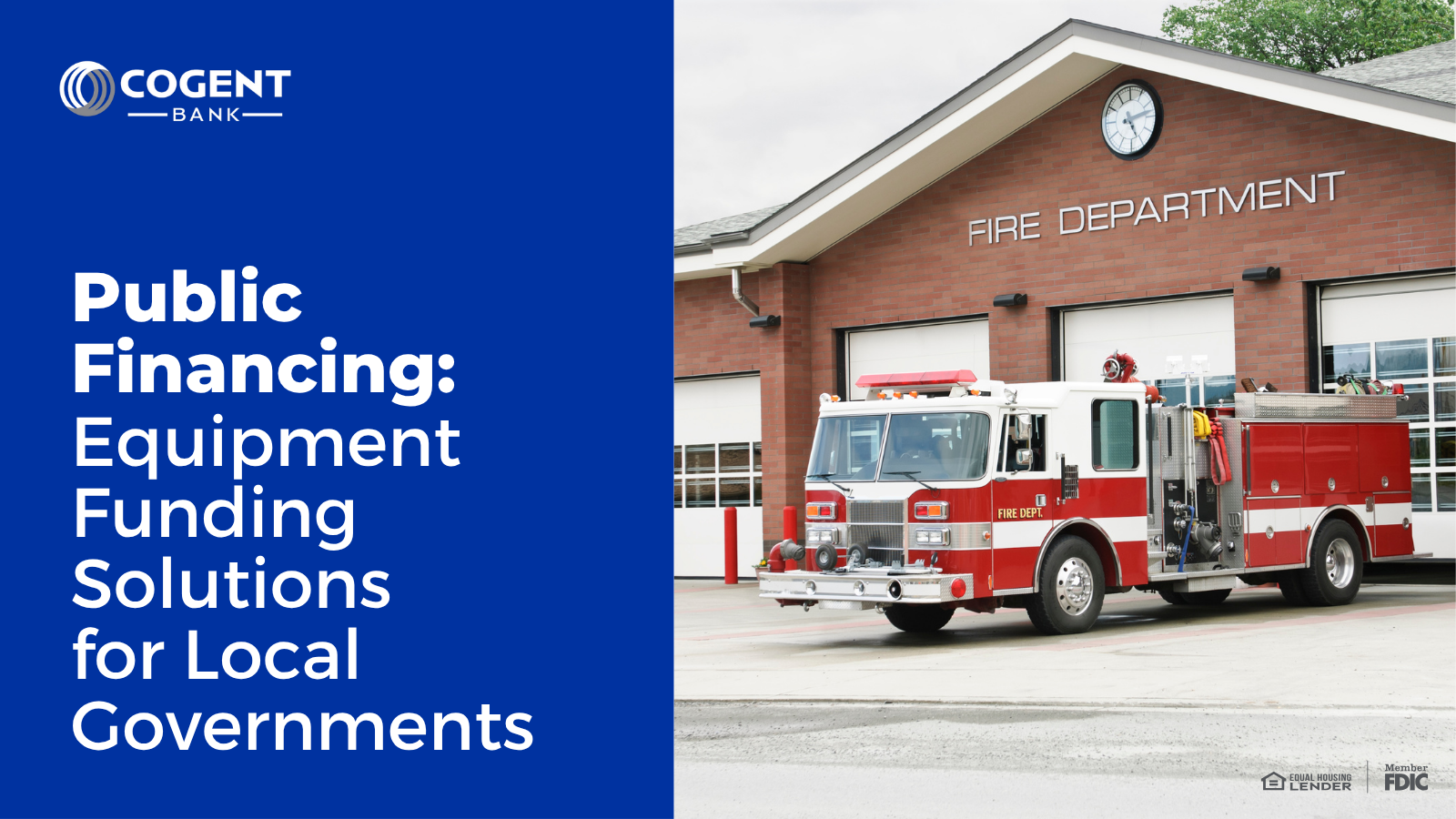
State and municipal governments face constant pressure to meet capital needs for essential equipment – whether it’s school buses, fire trucks, police vehicles, or IT systems. But how do they fund these purchases without launching a costly bond sale or navigating the complexities of a referendum. Public financing offers a streamlined, flexible solution that helps communities stay responsive.
Mike Horkey, Senior Vice President and Public Finance Manager at Cogent Bank, explains that public finance involves state and municipal governments and their agencies – entities with sovereign powers such as taxation, eminent domain, and law enforcement.
“When we talk about public finance or public banking, the question becomes, what does that mean? For us, it’s cities, school districts, state governments, agencies of state governments, towns, special purpose districts, things of that nature. These are tax-exempt entities that typically have one of three sovereign powers – many have all three,” Horkey says.
Cogent Bank sets up lending plans that allow these entities to borrow funds for the equipment they need to deliver services and maintain operations. While Cogent is based in Florida, they can also provide public financing all over the country.
“These things can range from telephone systems and computer systems to school buses, fire trucks, and even helicopters. The bigger the government, the more they’re buying,” Horkey says. “We provide tax-exempt financing to these governmental entities on a nationwide basis for essential purchases of capital equipment.”
These loans are offered through tax-exempt municipal leases – a term that often causes confusion. Unlike a consumer vehicle lease, municipal leases are structured as loans used to purchase equipment. They are frequently chosen over bonds, which require significantly more time and voter approval.
“A referendum must be held because there must be a tax associated with that bond to pay it back. Those voters are approving or disapproving not only of the issuance of the bond, but they’re also approving or disapproving of additional taxation,” Horkey says. “Often, they’ll throw everything into a referendum. They need a fire truck, but they might not need that new stadium, and if they’re thrown in together, they might not get either of them,” Horkey says.
“This is why we offer leases which do not require a vote. Bonds, also known as securities, do require a vote.” Municipal leases are not debt in the same way bonds are. Regular appropriations fund the payments, and they are listed as current expenses in the budget.
Cogent prefers working with governments that have general obligation bond ratings of A or better, signaling financial stability. Upon approval, funds are kept in escrow until the equipment is delivered and accepted.
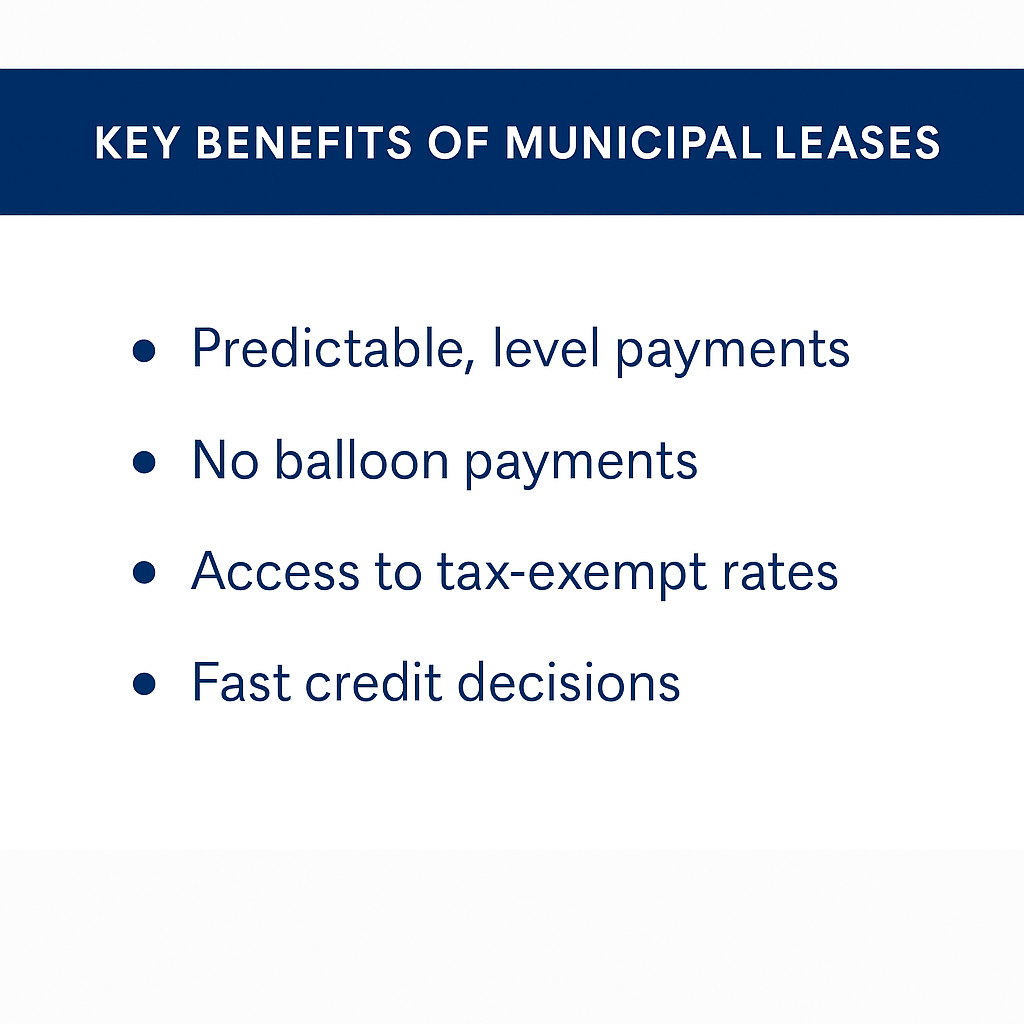
Government lease loans from Cogent are fully amortizing, meaning there are no large lump-sum payments at the end of the term.
“They get to borrow at a nice tax-exempt rate. They can borrow it for the useful life of that asset,” Horkey says. “Our loans are fully amortizing, so there aren’t any balloon payments, no need to meet the fair market value.”
Cogent’s hands-on approach provided by experts in public financing enables quick decision-making and competitive rates.
“Larger banks won’t touch any deal less than $1 million. We’ll do those smaller deals that the big banks don’t want,” Horkey says. “By playing in that area of the sandbox, it kicks out a substantial amount of competition.”
Most of Cogent’s government lending is overseen by federal agencies such as the IRS, the Department of the Treasury, and the Office of Foreign Assets Control (OFAC). Before issuing a lease, Cogent often requires a legal opinion confirming the agreement is valid within the proper jurisdiction.
Cogent packages its municipal lease loans and sells them to larger banks and insurance companies as investments. This allows Cogent to recycle capital and continue lending.
“We do that because we’re a small bank. It doesn’t make send for us to do hundreds of millions of these loans and keep them on the balance sheet,” Horkey says. “Our portfolio of loans tends to be very nicely risk-related and is considered exceedingly safe by most other banks.
Cogent also funds performance contracts with energy service companies (ESCOs) for projects that reduce energy costs and maintenance issues.
“Many municipalities haven’t upgraded their central plant for 30 or 40 years,” Horkey says. “We team up with ESCOs and utilities, and they’ll do a performance review to replace everything while guaranteeing that their Cogent Bank loan is sufficient to pay it back because of the savings involved.”
Public financing through municipal leases offers governments a practical, efficient way to acquire essential equipment and fund energy-saving upgrades – without the delays and risks of traditional bond sales.
For local leaders seeking smart, scalable solutions, Cogent Bank is a nimble and dependable partner in public finance – one that understands the needs of communities and delivers results with speed and integrity. Reach out today to learn more about how Cogent assists public entities with lending solutions. With strong knowledge and years of expertise, Cogent can help governments achieve the capital needs of the communities they serve.
Disclosures:
The information provided in this document is for educational and informational purposes only. It is not intended to be, and should not be construed as, investment, legal, tax, or accounting advice.
Non-deposit investment products are not insured by the FDIC or any other government agency, are not deposits or obligations of, nor guaranteed by the bank or any of its affiliates, and may lose value.
You should consult your own financial, legal, tax, and accounting advisors before making any decisions based on this information.